Introduction
The Indian Contract Act, 1872 is a law enacted by the British in India that governs contracts and agreements. It was drafted to protect both parties from unfair terms they may not have known about when agreeing, as well as to provide guidelines for when one party breaches the contract. This act is applicable entire India.
The Act is based on the principles of English common Law.
What is a contract in India
A contract is an agreement enforceable by law that offers personal rights and personal obligations.
Section 2(h) of the Indian Contract Act of 1872 defines Contract, the term Agreement defined in 2(e) of the Indian Contract Act of 1872.
Formation of contract meaning
The formation of a contract refers to the process through which parties create a legally binding agreement by fulfilling all the necessary elements such as Offer, Acceptance, Consideration, and Intention to create legal relations. Understanding the meaning and implications of a contract’s formation is essential to ensure that agreements are both valid and enforceable by law.
Definitions
Proposal / Offer
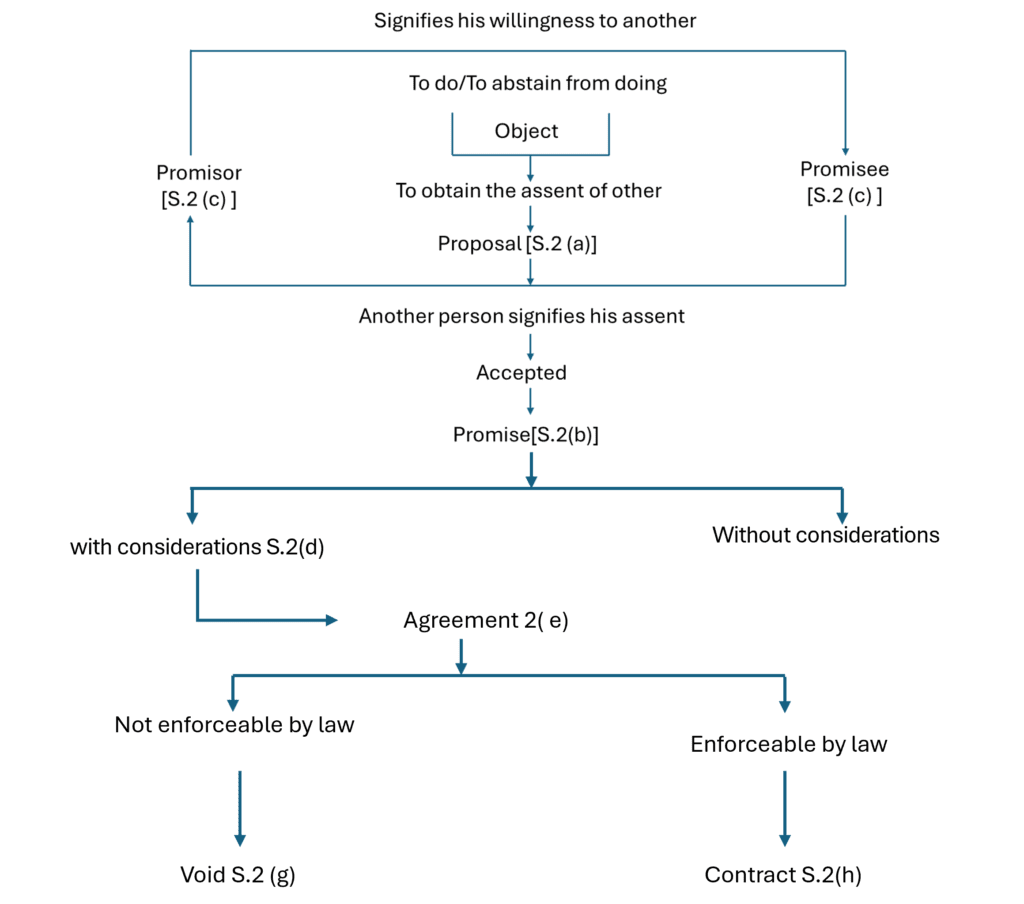
Section 2(a) of ICA defines “When one person signifies to another his willingness to do or to abstain from doing anything, with a view to obtaining the assent of that other to such act or abstinence is called a Proposal or Offer”.
Illustration 1
X offers Y to sell his car for rs 5,00,000/-, this proposal is called an offer.
Illustration 2
A proposes B, If you do not file a suit against me for defamation. I shall give you 1 Lakh rupees. The proposal is to abstain from doing something. It is called a negative proposal.
Acceptance and Promise
Section 2(b) of ICA defines “When the person to whom the proposal is made signifies his assent for the same thing in the same sense as proposed by the offeror”.
A proposal when accepted then it becomes a “Promise”.
Promiser and Promisee
Section 2(c) of ICA defines “The person making the proposal is called the Promisor, and the person accepting the proposal is called the Promisee”.
Consideration
Section 2(d) of ICA defines “consideration is the value for the promise, return one gets for his act or omission”.
Agreement = Offer+Acceptance
Section 2(e) of ICA defines “ Every promise and every set of promises, forming the consideration for each other, is an agreement”.
Contract
Section 2(h) of ICA defines “An agreement enforceable by law is a contract”.
Difference between contract and agreement
| Contract | Agreement |
| A contract is an agreement that is enforceable by law | Agreements not enforceable by law |
| All contracts are agreements | All agreements are not contracts |
| The contract creates a legal binding between the parties. | Agreements don’t create any legal relation. |
| A contract is only legally enforceable. | An agreement must be socially acceptable. It may or may not be enforceable by the law. |
Void
Section 2(g) of ICA defines “An agreement not enforceable by law is said to be void”.
When a contract is Void
- The contract was formed during the night
- The contract made in forest
- Contract made in a secret place
- Contract made of violent attack and affray
- The contract was made in celebration of the Marriage
Voidable
Section 2(i) of ICA defines “An agreement which is enforceable by law at the option of one or more of the parties thereto, but not at the option of the other or others, is a voidable contract”.
Conclusion
The Indian Contract Act, 1872 prescribes the law relating to contracts in India and is the key act regulating Indian contract law. The Act is based on the principles of English Common Law. It applies to all the states of India.